

What Is Shopify AI SEO? A Complete Guide on eCommerce AI Search Optimization
Bassem is a digital marketing, SEO, and AI strategist with more than 22+ years of experience managing online marketing strategies for some of Canada's and international corporations, including Canadian Tire, VistaPrint, Remax Canada, Egypt Air, Xplornet, Direct Energy, and Toronto Star.
Key Takeaway: Traditional search engine optimization focused on keyword-to-page matching. In 2026, algorithmic systems crawl, parse, and synthesize backend data to generate direct answers. To stay visible, eCommerce storefronts must evolve from simple visual design layouts into high-speed, structured databases.
If you have ever felt like you are shouting your brand's message into an empty void while your direct competitors walk away with all the cash, you are not alone, but you are running out of time. Just last week, we spoke with a Shopify merchant who had burned through $50,000 on traditional paid search advertisements. Their brutal wake-up call came when they realized their high-intent target customers were completely bypassing their links to ask ChatGPT for buying recommendations instead.
Clinging to obsolete tactics means you are essentially trying to navigate a shifting digital terrain with a useless paper map. We have seen established businesses face an absolute extinction event overnight because they ignored the decoupled reality where search happens everywhere, on TikTok, Reddit, and inside AI brains, not just the traditional Google search bar.
To understand how to protect your business from disappearing entirely, you have to look directly at the underlying mechanics of this new shift and evaluate how the foundational playbook of the internet has been rewritten.
How AI SEO Has Changed Shopify E-Commerce Search
The traditional digital marketing playbook for e-commerce is broken. For over two decades, Shopify store owners followed a simple, predictable sequence for their eCommerce SEO efforts: select a handful of high-volume target keywords, write targeted text pages, accumulate backlink signals, and compete for a spot in the top ten blue links on Google. If you managed to secure a ranking on the first page, your business thrived on a steady stream of user clicks and predictable customer traffic.
Today, that model has been disrupted by a Zero-Click Reality. Google’s broad core algorithm updates have permanently integrated advanced machine-learning quality thresholds into search indexing.
With that disruption, the traditional blue link is dying, and e-commerce operators who continue to rely on obsolete search tactics are rapidly losing their market share. We have officially entered the AI or DIE era of digital marketing.
We are now living in a world ruled by Answer Engines. When a consumer looks for a product, they are no longer presented with a basic list of URLs. Instead, they encounter Google’s AI Overviews or Large Language Models (LLMs) like ChatGPT, Gemini, and Perplexity. These platforms do not simply point users to alternative web addresses; they deliver final answers directly on the results screen.
This structural evolution has driven a massive shift in consumer behavior. The window for capturing consumer interest has narrowed down to minutes. When a buyer receives a clear, comprehensive summary of their query instantly, their motivation to click through to an external storefront drops significantly, leading to a zero-click reality.
To survive in this new ecosystem, your brand's operational goals must transform completely. AI SEO for Shopify is no longer about ranking blue links. It is about becoming the preferred source for humans and AI systems across every single stage of discovery. If your digital storefront is not engineered to act as a primary source of truth for AI, your products will become completely invisible right when a customer is standing by with an open wallet.
So, how do you become the answer on AI platforms? Hint: it’s not keywords.
Learn More About AI SEO for Shopify



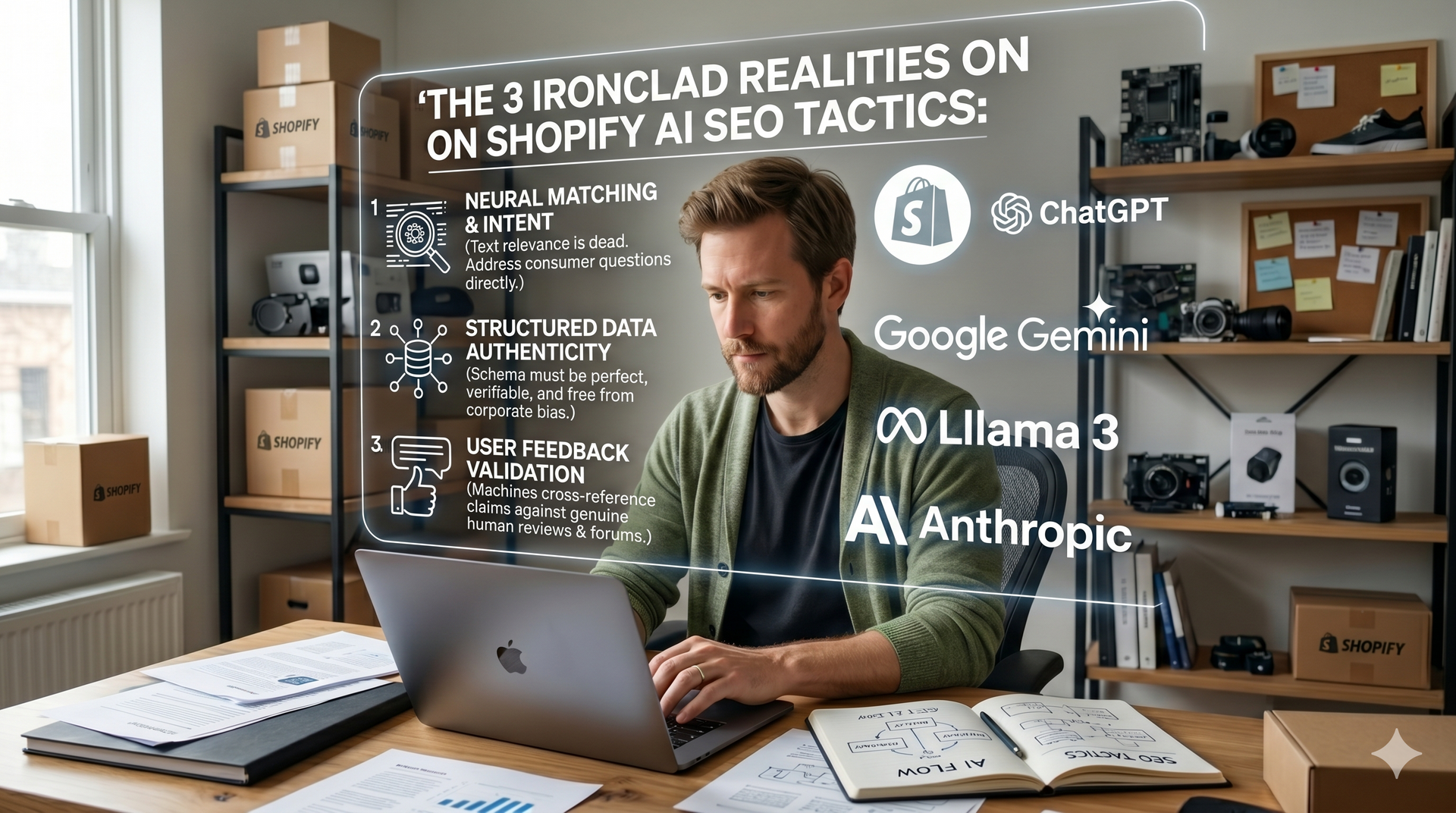
How AI Retrieves Information from Shopify
Contrary to what many store owners believe, AI platforms don't simply look for pages containing the exact keywords in a user's query. Instead, they try to understand what the user is really asking and then gather information from multiple sources to generate an answer.
When someone asks ChatGPT, Google AI Overviews, Gemini, or Perplexity a question, these systems don't simply look for pages containing the exact keywords. Instead, they analyze the intent behind the question and gather information from multiple sources.
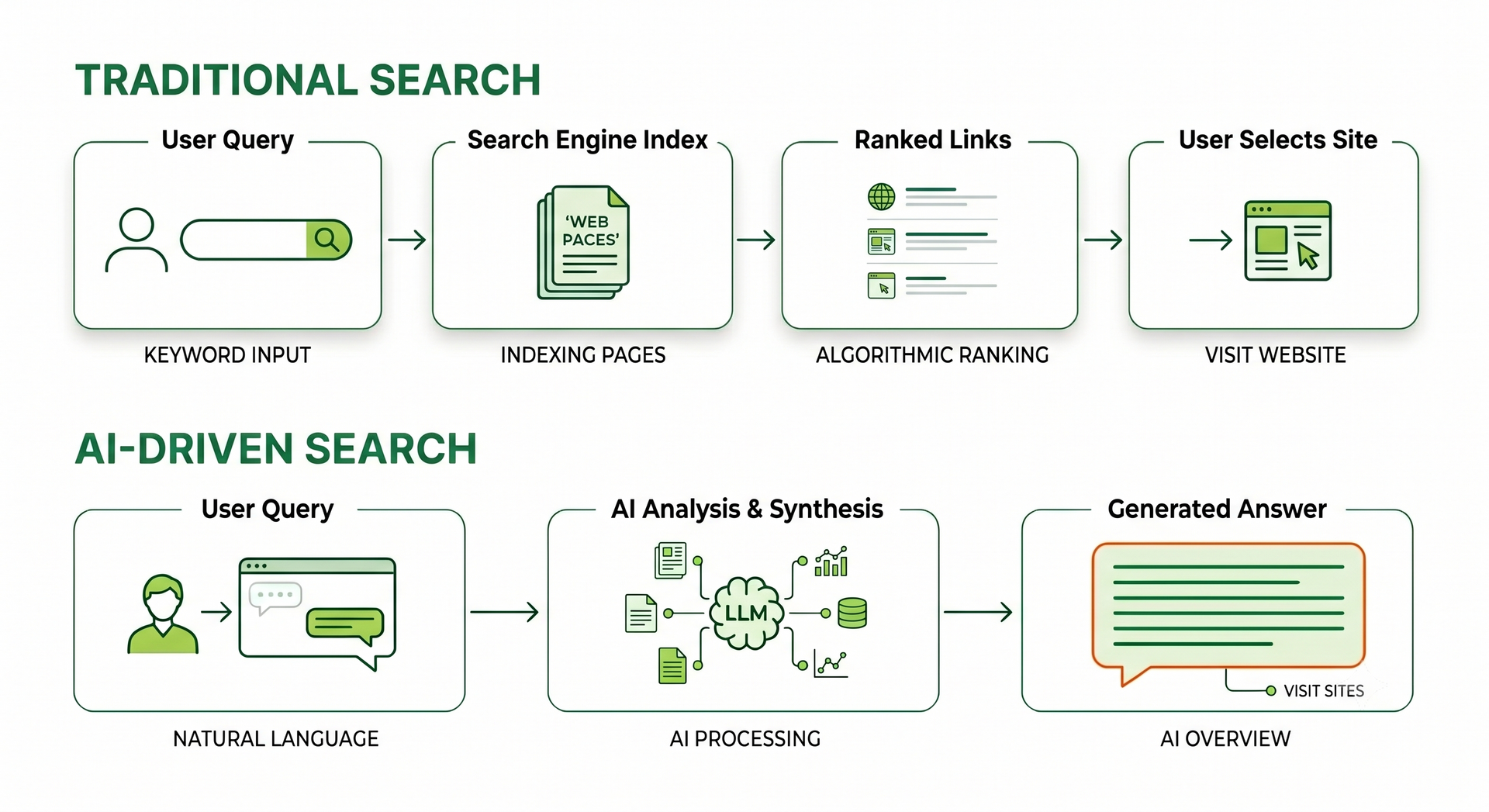
For example, if someone asks for the most durable deck screws available in Ontario, AI systems don't search for pages that repeat that exact phrase. They compare information from different websites and evaluate factors such as:
- Product specifications
- Reviews and ratings
- Content quality
- Freshness of information
- Brand reputation
- Technical structure
Sources that provide clear, accurate, and trustworthy information are more likely to be cited. Generic content that simply repeats information already available elsewhere becomes easier for AI systems to ignore.
This is why technical SEO and structured data still matter. AI systems need to understand your products, pages, and brand before they can confidently recommend them.
In the AI era, your Shopify store should do more than look good. It should provide information that both customers and machines can easily understand and trust.
The Shopify AI SEO Visibility Framework
Achieving consistent visibility in this new landscape requires a shift away from isolated, one-off optimization campaigns. It requires a system that builds trust and authority across both search engines and answer engines. This is the framework we use to help Shopify brands build long-term visibility across Google, ChatGPT, Gemini, Perplexity, and other answer engines.
- Technical Foundation: Building web properties that prioritize machine readability allows search crawlers to parse and index your data without friction.
- AI-Friendly Content: Organizing your insights into clear, modular data blocks makes it easy for answer engines to seamlessly extract and use your information.
- Authority Signals: Verifying business facts through structured schema tags, independent review networks, and third-party validation engines builds deep entity trust.
- Social Discovery: Cultivating user discussions, community mentions, and video transcripts across networks like Reddit, YouTube, and TikTok creates a strong footprint of real-world authority.
- AI Citations: Gaining recognition from answer engines as an undisputed source of truth unlocks a major surge in recommendations within generative summaries.
- Branded Search: Seeing your brand regularly cited by AI assistants drives consumers to search for your business by name on Google, signaling to primary search algorithms that you are a trusted market leader.
Over time, these signals work together to increase your overall authority. The result is greater visibility across both search engines and AI platforms, stronger resilience against algorithm updates, and a competitive advantage that becomes increasingly difficult for other stores to replicate.
Let's break down each component of the framework, starting with the foundation that everything else depends on.
Building a Strong Technical Foundation in Shopify
The first critical stage of effective Shopify SEO requires optimizing the code layer of your Shopify storefront. Many legacy e-commerce templates rely on heavy script execution and tangled code structures. While these elements might look visually appealing to a human visitor, they pose a major barrier for machine crawlers. If your product variants, pricing tiers, or inventory counts are hidden behind complex code, AI search agents cannot access the information during real-time retrieval sweeps.
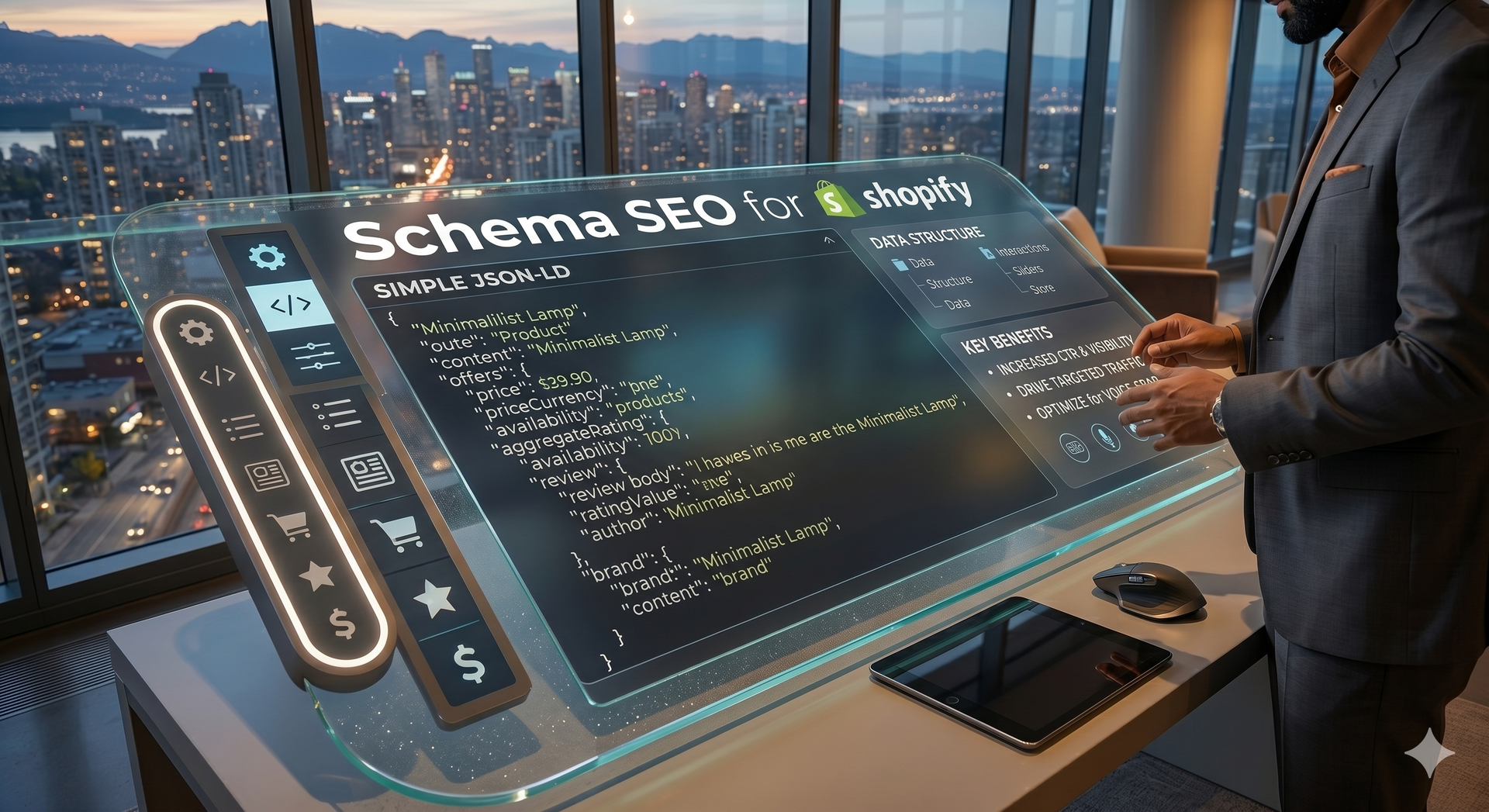
Your Shopify store must become a clean, AI-friendly data source.This is where the technical hygiene of your store becomes a matter of survival. We often see stores with messy JSON-LD structured data. If Google's crawlers or other bots cannot fetch your data with 100% confidence, they will skip your business entirely.
| Element | Why It Matters | How To Optimize |
|---|---|---|
| Flat Site Structure | Makes products easier to crawl and discover. | Keep important pages within 2–3 clicks from the homepage |
| Clean Sitemaps | Helps search engines index your pages efficiently. | Maintain XML sitemaps and properly configure robots.txt |
| Google Merchant Center Sync | Keeps pricing and inventory accurate for AI shopping results. | Connect your catalog through Shopify feeds or APIs |
| JSON-LD Schema | Helps AI understand your products and business. | Implement Product, Review, FAQ, and Organization schema |
| Duplicate URL Cleanup | Consolidates authority and avoids confusion. | Use canonical tags and eliminate duplicate pages |
| Fast Core Web Vitals | Improves visibility and user experience. | Optimize images, apps, code, and page speed |
When we audit stores at our digital marketing agency, we find that technical errors are the silent killers of growth. You might think your site looks great to a human, but if it looks like garbage to a machine, you’re finished. This is the technical reality of the modern web.
Creating Content That Helps AI Recommend Your Products
With a strong technical foundation in place, the next step in any AI SEO strategy is creating content that helps search engines and AI platforms understand what your brand, products, and expertise are all about.
In the past, content strategies focused heavily on keyword density and word count. Brands published long articles targeting exact-match phrases in the hope of ranking for as many searches as possible.
Today, search engines and answer engines have evolved beyond simple keyword matching. They rely on semantic understanding and Entity SEO to determine which brands deserve to be recommended.
Instead of asking, "How many times should I mention this keyword?", the better question is, "What topics, products, and problems should my brand become known for?"
Keywords Explain Pages; Entities Define Brands
Entity SEO focuses on building clear relationships between your products, expertise, customers, and industry. Search engines and AI systems use these connections to understand your business in context.
For example, a Shopify store selling outdoor furniture shouldn't just target keywords like "patio chairs" or "outdoor tables." It should establish itself as an authority around broader topics such as:
- Outdoor living
- Weather-resistant materials
- Backyard design
- Patio maintenance
- Furniture care
Over time, these interconnected topics create a strong semantic footprint that helps search engines and AI platforms associate your brand with your niche.
Match Search Intent, Not Just Search Terms
Modern AI systems also prioritize intent over exact phrases. Someone searching for:
- "Best patio furniture for Canadian winters"
- "How to protect outdoor furniture from snow"
- "Weather-resistant patio sets"
...may ultimately be looking for the same solution.
Rather than creating separate pages for every keyword variation, focus on addressing the underlying questions and problems your customers are trying to solve.
Build Topical Authority Through Content Clusters
To build deep topical relevance, you need to create supporting content that reinforces your expertise across the web. This approach has become one of the foundations of modern Shopify SEO, especially in the era of AI-driven search. This includes structured resources like buying guides, product comparisons, detailed FAQs, maintenance tips, and customer stories. When search engines and AI platforms consistently associate your brand with a core topic, they see your store as a true authority. This makes them much more likely to surface your content and recommend your products to shoppers.
The goal is not to rank for thousands of disconnected keywords. Instead, you want to use tight internal linking and clear breadcrumb schema to help search engines map your site structure.
Internal links connect your supporting articles directly back to your main product collections, showing AI engines exactly how your topics relate to each other. Adding structured breadcrumb schema gives the machine layer a clear, text-based trail of your site hierarchy. When search platforms can easily trace these paths, they understand your semantic intent and become much more likely to surface your content and recommend your products.
Structuring Chunk-Level Content for GEO for eCommerce Wins
In the modern answer-engine ecosystem, your content strategy must adapt to how machines extract information. This shift requires a deep understanding of GEO (Generative Engine Optimization)—the specific process of optimizing your website data so that AI models natively trust, extract, and recommend your brand inside conversational search summaries.
Unlike traditional search optimization that focuses on whole pages and keyword density, GEO is built around how AI retrieval systems break web documents down into small, distinct text modules, or chunk-level components, to pull precise answers for user queries. If your best insights are buried inside long, rambling paragraphs, the machine layer will pass over your content in favor of a competitor who uses GEO principles to present data clearly
To secure your place as a trusted source that generative engines choose to cite, your on-page data must be easy for software to isolate.
- The Lead Answer Block: Start your articles with a 40-to-75 word canonical summary block that provides immediate, clear value for both human readers and machine scanners.
- Semantic Headings: Organize your text into distinct modules using descriptive, question-mirroring headers that match natural language conversational queries.
- Structured HTML Tables: Use clean, semantic tables for product comparisons, pricing, and technical specs because AI retrieval models prefer structured data formatting.
When you optimize your content structure for chunk-level retrieval, you dramatically increase your citation share inside generative summaries. The AI needs to easily match the deep intent behind a user command with your specific product solution. By organizing your pages into high-clarity data modules, you provide the exact text structure that the machine layer wants to reference and recommend.
Building Brand Authority Beyond Your Shopify Store
Creating a technically sound Shopify store and publishing helpful content are only part of the equation. Modern answer engines do not evaluate your website in isolation. They constantly compare information across the broader web to determine whether your brand deserves to be recommended.
Strong off-page trust signals have become one of the most important pillars of modern AI SEO, especially as answer engines increasingly validate information across multiple sources.
Think of your website as your official story. Reviews, media mentions, videos, and community discussions are independent witnesses. The more these signals align, the easier it becomes for search engines and AI systems to trust your business.
Reviews and User-Generated Content
One of the simplest ways to strengthen your authority is to encourage customers to share their experiences. Reviews, testimonials, photos, videos, and Q&A sections provide evidence that real people are buying and using your products. A single 0.1-star increase in your review rating can lead to a 5% to 9% increase in business revenue. Furthermore, e-commerce stores with a strong volume of positive reviews earn 54% more revenue on average.
You can build these signals through automated post-purchase emails, simple review requests, loyalty programs, and small incentives for customers to share photos and videos. Besides increasing immediate trust with human shoppers, user-generated content creates fresh, authentic information that AI systems can reference when evaluating your products. For service brands expanding into retail across Ontario, Canada, consistently collecting these real-world reviews confirms your true business identity to search bots and provides the user engagement data that algorithms love.
Digital PR and Brand Mentions
Search engines are far more likely to trust brands that are mentioned beyond their own websites. This is where digital PR comes in to bridge the gap. Earning high-level media channels and references acts as a massive credibility signal for AI models that employ retrieval-augmented generation to ground their answers.
You can build these signals by publishing original research, sharing proprietary trade insights, partnering with influencers, or pitching stories to journalists and niche publications. Even unlinked brand mentions help establish your authority by showing that your business is recognized within its industry. Sharing interesting trade stories or specialized expertise with local journalists covering competitive Canadian hubs like Toronto and North York makes them much more likely to write about your brand and include a direct connection back to your Shopify store.
Reddit, YouTube, and TikTok
Consumers increasingly discover products through communities and videos rather than traditional search results. AI systems follow the exact same pattern by analyzing discussions and video transcripts to understand what products real people trust and recommend. If your brand is completely absent from these social spaces, generative engines will perceive your business as less relevant to current consumer conversations.
You can expand your presence by creating helpful tutorials, comparison videos, buying guides, and product demonstrations. Participating in Reddit discussions and encouraging customers to share their experiences on social media also helps create authentic conversations around your brand. Consistently distributing high-value text and video content across these independent networks ensures that your brand entity gets cited when generative engines compile their final answer summaries.
Building a Consistent Brand Presence
Authority grows when your information is completely consistent across the web. Search engines cross-reference your business details to verify your identity, regional footprint, and trustworthiness.
Make sure your brand name, descriptions, social profiles, product information, and contact details remain identical across directories, marketplaces, review platforms, and social channels. For example, whether you run a Shopify store from Toronto, North York, or anywhere else in Ontario, Canada, maintaining uniform data allows search platforms to easily verify your location and authority. The easier it is for machines to connect these signals, the more confidence they have in recommending your store.
The brands that win in AI SEO are not necessarily the loudest. They are the ones with the strongest network of trust signals across the web.
Measuring AI Visibility for Your eCommerce Brand
Tracking keyword rankings alone is like checking the weather by looking at last month's forecast. It tells you very little about the invisible forces actually influencing how customers discover your products. Search has shifted beyond blue links, and many buying journeys now begin and end inside AI Overviews, ChatGPT conversations, Reddit threads, and product recommendations. If you are only watching clicks and positions, you are missing the bigger picture.
Modern Shopify brands need an AI visibility dashboard because successful AI SEO campaigns rely on much more than keyword rankings. Instead of obsessing over rankings alone, you need to understand your citation share across answer engines, monitor branded search growth, and track how often your products and content are surfaced inside AI-generated responses. Visibility is no longer measured solely by traffic. It is measured by how often your brand is discovered, trusted, and recommended.
We have found that some of the highest-converting traffic comes from what we call the "Invisible Funnel." A customer sees your brand cited in an AI Overview, encounters your products again on YouTube or Reddit, and later searches for your store directly. Traditional attribution models often fail to capture these touchpoints, causing businesses to underestimate the channels that are quietly driving revenue.
To make sense of this new reality, monitor metrics such as:
| Metric/KPI | What It Measures | How to Measure |
|---|---|---|
| AI Citation Frequency | Brand mentions in AI answers | Profound, Peec AI, Scrunch AI |
| Branded Search Growth | Demand for your brand | Search Console, Google Trends |
| AI Overview Appearances | Visibility in AI summaries | Semrush AI Toolkit, manual searches |
| Share of Voice | Visibility versus competitors | Ahrefs, Semrush, Profound |
| Merchant Center Impressions and Clicks | Product discovery performance | Google Merchant Center |
| Review Volume and UGC | Trust and social proof | Shopify Reviews, Trustpilot, Reddit |
| Organic and Assisted Conversions | Revenue from organic channels | GA4 attribution reports |
If you are not measuring these signals, you are making decisions with incomplete information. In a zero-click world, visibility compounds quietly. The brands that understand these hidden patterns are the ones that will continue to grow while everyone else wonders where their traffic went.
Preparing for the Next Phase of Search With an AI SEO Agency
The next phase of search looks completely different from the one that built the modern web. Consumers now rely heavily on Google AI Overviews, ChatGPT, and conversational search tools to research products, compare options, and make buying decisions. Instead of manually typing keywords into a search bar and browsing ten blue links, shoppers delegate research to devices that identify the best option based on preferences, budget, and requirements. These advanced systems do not recommend brands at random; they favor businesses that maintain clean data, trustworthy content, and strong signals across the web.
This shift creates a massive opportunity for brands that move early. Businesses that embrace AI SEO today are positioning themselves to dominate the next generation of search. If you rank number one in traditional organic SEO right now, you already have a greater than 50% chance of appearing directly in the Google AI Overview. By following a balanced framework that allocates roughly 70% of effort toward core Shopify SEO, 20% toward social discovery, and 10% toward emerging AI opportunities, e-commerce businesses can build immense resilience against changing algorithms. Ultimately, the brands that thrive will be those that treat their websites as a verified source of truth, investing in technical foundations and creating content that answer engines can easily cite.
Our team often sees merchants who want to scale but do not know how to handle these rapid algorithm shifts. Green Lotus Digital Marketing Agency helps e-commerce businesses implement AI SEO, local SEO, digital marketing, and advanced sales automation. Let our team build your custom visibility playbook and contact Green Lotus Digital Marketing Agency today to protect your brand and grow your organic reach across the modern web.
Frequently Asked Questions
What is the difference between traditional SEO and AI SEO for Shopify?
Traditional SEO focuses on ranking for specific keywords in a list of blue links. AI SEO for Shopify focuses on making your store the "source of truth" for AI models like ChatGPT and Google's AI Overviews. This requires technical files like llms.txt and high-density structured data. While traditional SEO helps humans find you, AI SEO ensures that the "Judge" (the AI) recommends your products when a user asks a conversational question. It is about being cited, not just listed.
How does Green Lotus help with technical Shopify leaks?
Our agency specializes in hard-coding Shopify themes to eliminate duplicate URL paths and consolidate ranking power. We ensure every internal link points to the canonical product URL, preventing "link juice" from being spread too thin. Additionally, we implement advanced schema markup and AI-readable sitemaps. These technical adjustments ensure that AI crawlers can index and understand your store's data with zero friction. We essentially fix the "leaky bucket" of your website before we start driving high-intent AI traffic to it.
Why should I choose an AI SEO agency over a traditional marketing firm?
Traditional firms often focus on "traffic," but we focus on "being the answer." Most agencies are still using old-school strategies that are becoming obsolete as Google shifts to AI Overviews. Our AI SEO agency provides white-glove services, including 24/7 AI agents and "Smart Sites" that rank up to eight times faster. We offer a 30-day money-back guarantee and no contracts because we are confident in our results. We don't just get you clicks; we architect systems that close sales.