

What Is Shopify SEO? A Complete Guide to Ecommerce Search Engine Optimization
Bassem is a digital marketing, SEO, and AI strategist with more than 22+ years of experience managing online marketing strategies for some of Canada's and international corporations, including Canadian Tire, VistaPrint, Remax Canada, Egypt Air, Xplornet, Direct Energy, and Toronto Star.
Key Takeaway: Shopify SEO is no longer just about rankings. Brands that build trust, structure, and authority will be the ones AI platforms recommend.
What if ranking number one on Google no longer guarantees customers for your Shopify store? For years, e-commerce brands competed for a single prize, which was a spot in the top ten blue links on a search results page. The formula was predictable. You worked hard on search engine optimization, ranked higher, captured more clicks, and generated more sales.
Search has changed completely in the years since. Google AI Overviews, conversational answer engines, and rich features are capturing more user attention than ever before. Recent studies suggest that between 58% and 68% of Google searches now end without a click to an external website because users get their answers directly from synthesized summaries. The rules of e-commerce survival have changed with them.
When we audit online stores at Green Lotus Agency, we see many brilliant entrepreneurs who are still using what equates to an old paper map to navigate a shifting digital terrain. We talk to Shopify store owners across North America, and they share the exact same frustration: they publish content, invest their time, and follow the traditional playbook, yet their growth is flattening out.
In many cases, their buyers are bypassing standard links entirely to ask conversational assistants for direct product recommendations instead. Clinging to old methods means you are missing the massive shift where discovery happens inside artificial intelligence engines, not just standard search bars. To keep your storefront visible, you must understand how to look like a trusted source to both humans and machine learning models. This Shopify SEO guide will show you how to protect your store, capture modern traffic, and ensure AI systems confidently recommend your products.
What is Shopify SEO
Shopify SEO is the process of optimizing your Shopify store so that search engines and AI platforms can easily find, understand, and recommend your products.
Years ago, e-commerce optimization focused heavily on keyword-to-page matching. If your text contained the exact phrase a user typed, you had a strong chance to surface on the results grid. Modern Shopify SEO requires treating your online store like a high-speed, structured database rather than a simple collection of visual design layouts.
Rankings alone are no longer enough to sustain growth. When a customer uses an AI shopping assistant, they do not receive a basic list of URLs. They get a final, synthesized answer directly on their screen. To survive, your brand must evolve from merely ranking to becoming the preferred source of truth that AI models confidently cite.
Why SEO Matters for Shopify Stores
Search engines remain one of the most valuable sources of customers for Shopify merchants. Unlike paid ads, SEO compounds over time, creating a long-term asset that can consistently attract qualified buyers. According to Search Engine Journal, SEO leads have an average close rate of 14.6%, significantly higher than the 1.7% average for traditional outbound marketing.
Today, SEO is about more than rankings. AI Overviews, ChatGPT, Gemini, Perplexity, and other answer engines are becoming part of the buying journey. As shoppers increasingly rely on these platforms for recommendations, strong SEO foundations help ensure your store remains visible wherever customers are searching.
We've seen this firsthand. At Green Lotus, we implemented this data-first optimization framework for T1 Motorsports, an automotive eCommerce brand. Within the first 14 months, the company generated more than $1 million in organic sales. Over the next two and a half years, total sales increased by 505%, while keyword rankings grew by 2,560%, making T1 Motorsports the second-ranked competitor in Canada. Most notably, 23% of its organic revenue in the final quarter came directly from ChatGPT recommendations.
These results highlight an important reality for Shopify merchants. Modern SEO is no longer just about rankings. It is about building the trust and authority that both search engines and AI platforms rely on when recommending products.
Learn More About eCommerce SEO




The Key Pillars of Shopify SEO
One of the goals of this Shopify SEO Guide is to provide a framework that helps merchants move beyond isolated tactics and build long-term visibility across both search engines and answer engines. You need a complete system that builds trust and authority across both search engines and answer engines.
Our team at Green Lotus Agency uses a balanced framework that splits your digital marketing efforts into distinct focus areas to ensure consistency across search systems and conversational platforms.
- Technical Shopify SEO: Building web properties that prioritize machine readability so search crawlers parse data without friction.
- On-Page Shopify SEO: Optimizing the text, headings, images, and links that human buyers and search indexers interact with every day.
- Off-Page Shopify SEO: Building third-party trust and authority across independent review portals and industry networks.
- Local Shopify SEO: Structuring regional landing pages and map profiles for businesses serving specific cities.
- Schema SEO: Embedding structured microdata tags to serve as a direct translator between your storefront and AI models.
- Shopify AI SEO: Structuring your online data so that conversational assistants can easily extract, trust, and cite your store as a direct recommendation.
Technical Shopify SEO
Technical SEO is the foundation of every successful Shopify store. Before search engines, AI Overviews, and answer engines can rank or recommend your products, they must first be able to access and understand your website. Unfortunately, many stores focus on visual design while neglecting the underlying infrastructure that powers discoverability.
A technically sound store helps search engines crawl pages efficiently, understand relationships between products and collections, and surface the right information to shoppers. It also reduces the risk of duplicate content, indexing issues, and slow page experiences that can negatively impact both rankings and conversions.
As AI-powered search becomes more prevalent, technical SEO takes on an even greater role. Search engines and answer engines need fast access to structured information. If critical product details are hidden behind bloated code, broken links, or inaccessible page paths, machines may struggle to retrieve that information and turn to competing stores instead.
Fortunately, most technical improvements revolve around a handful of core areas. By maintaining a logical site structure, ensuring pages are crawlable, optimizing speed, and delivering a strong mobile experience, Shopify merchants can build a foundation that supports every other aspect of SEO.
| Technical Element | Why It Matters | Optimization Targets |
|---|---|---|
| Site Structure | Helps search engines and users navigate your store efficiently. | Flat architecture, logical collections, important pages within 2-3 clicks |
| Sitemap and Robots.txt | Guides crawlers toward important pages and away from unnecessary ones. | Clean XML sitemap, properly configured robots.txt, blocked low-value pages |
| Crawlability and Indexing | Ensures products and collections can be discovered and indexed correctly. | Canonical tags, broken link fixes, duplicate content prevention |
| Site Speed and Core Web Vitals | Improves user experience and reduces friction for search engines and shoppers. | Image compression, code optimization, fast server response, Core Web Vitals |
| Mobile Experience | Supports the growing number of searches and purchases occurring on mobile devices. | Responsive design, mobile usability, stable layouts, touch-friendly navigation |
Technical SEO may not be the most visible part of Shopify SEO, but it provides the foundation that allows every other optimization effort to succeed.
On-Page Shopify SEO
If technical SEO determines whether search engines can access your store, on-page SEO determines whether they understand it. It focuses on the pages your customers interact with every day and the signals that help search engines and AI platforms interpret your products, content, and overall expertise.
This pillar is often where the biggest gains happen. Strong on-page SEO helps attract qualified traffic, improve conversions, and establish topical authority within your niche. It also provides the context that answer engines and AI shopping assistants need to confidently recommend your products. Without it, even the fastest and most technically sound Shopify store can struggle to compete.
Modern on-page optimization goes far beyond keyword placement. Search engines no longer evaluate pages in isolation. They analyze how your products, collections, content, and internal links work together to answer customer questions and guide shoppers toward a purchase. In other words, the goal is not to optimize individual pages, but to build a connected ecosystem that serves both humans and machines.
Keyword Research and Semantic Intent
Modern search engines prioritize intent over exact-match keywords. Instead of creating separate pages for every keyword variation, focus on understanding the questions your customers are trying to answer. Educational blog posts, buying guides, comparisons, and FAQs help establish topical authority while supporting customers throughout their buying journey.
As search evolves, content plays an increasingly important role in visibility. Search engines and AI platforms want to recommend sources that demonstrate expertise, not just pages that repeat keywords. By building a library of helpful content around your products and industry, you create a stronger ecosystem that attracts buyers at every stage of the customer journey.
Product Page Optimization
Your product and collection pages are the revenue-generating assets of your Shopify store. While blog content builds authority, these pages turn visitors into customers. They should do more than list specifications. They should help shoppers understand what a product does, who it is for, and why it is worth buying.
Collection pages deserve just as much attention. Instead of acting as simple grids of products, they should provide context about the category and help customers navigate your inventory. Together, these pages give search engines and AI systems the information they need to surface your products for relevant searches.
When optimizing these pages, focus on providing both shoppers and machines with the information they need to make confident decisions:
- Write unique product descriptions instead of relying on manufacturer copy.
- Emphasize benefits and real-world use cases, not just technical specifications.
- Include product images, videos, reviews, and FAQs to answer common questions.
- Add introductory copy to collection pages to provide category context.
- Recommend related products and complementary items to improve navigation and cross-sells.
- Use clear calls-to-action and trust signals to reduce friction during the buying process.
Strong product and collection pages do more than drive conversions. They create a richer source of information that search engines and AI platforms can understand and recommend. In an era where discovery increasingly happens through AI Overviews and answer engines, the stores that provide the most helpful and complete information are often the ones that earn visibility.
Site Architecture and Page Structure
Strong on-page SEO also depends on how your pages connect to one another. Internal links help distribute authority across your store and create clear relationships between products, collections, and content. At the same time, descriptive titles, headings, and metadata help search engines interpret the purpose of each page.
These structural elements may seem minor, but together they help create a better experience for shoppers while making your store easier for search engines and AI platforms to understand.
| Area | Optimization Targets |
|---|---|
| Internal Linking | Contextual links, anchor text, product-to-blog connections |
| Metadata | Title tags and meta descriptions |
| Headings | Logical H1-H3 hierarchy and descriptive headings |
| Page Structure | Scannable layouts, lists, tables, and FAQs |
| Navigation | Menus, breadcrumbs, and clear category organization |
When these elements work together, your Shopify store becomes more than a collection of pages. It becomes a connected ecosystem that helps search engines, AI platforms, and customers navigate the buying journey with confidence.
Off-Page Shopify SEO
our website tells search engines and AI platforms what your business says about itself. Off-page SEO provides the independent evidence that validates those claims. Reviews, backlinks, media coverage, and brand mentions all contribute to your reputation and authority across the web.
This pillar has always been important for traditional SEO, but it plays an even bigger role in the age of AI. Search engines and answer engines increasingly rely on external consensus to evaluate which brands deserve visibility. A business that is consistently referenced by reputable sources is easier for both humans and machines to recognize and trust.
Digital PR has become one of the most effective ways to build this authority. Unlike traditional link building, which focuses on acquiring backlinks one at a time, digital PR generates broader recognition through original research, expert insights, industry commentary, and media coverage. These efforts create a network of mentions that strengthens your brand across multiple channels.
When building off-page authority, focus on:
- Earning high-quality backlinks from reputable websites and publications.
- Publishing original research and expert insights that naturally attract media coverage.
- Encouraging customer reviews and user-generated content.
- Building a strong presence on review platforms and marketplaces.
- Generating brand mentions across forums, podcasts, social media, and videos.
- Participating in industry communities and discussions.
- Distributing valuable content that earns citations and shares.
Unlike technical or on-page SEO, off-page SEO cannot be optimized overnight. Authority must be earned. However, businesses that consistently invest in reputation and external trust signals often develop a competitive advantage that is difficult to replicate. The same endorsements that help your rankings today may also increase the likelihood that AI platforms surface and recommend your brand tomorrow.
Local Shopify SEO
Not every Shopify business needs local SEO. However, if you operate a physical location, serve specific cities or regions, or combine ecommerce with in-person services, local visibility can become a powerful source of high-intent traffic and customers.
Local SEO helps search engines understand where your business operates and who it serves. This information becomes especially important when customers are searching for products or services nearby. It also helps AI platforms and search engines validate your business through multiple sources, reinforcing your credibility within a particular market.
Building a strong local presence goes beyond simply adding a city name to your website. Search engines cross-reference your business information, reviews, and online footprint to confirm that your company is active and trustworthy within the regions you serve.
To strengthen your local presence, focus on:
- Optimizing your Google Business Profile with accurate hours, categories, and contact information.
- Maintaining consistent business details across directories, review platforms, and social channels.
- Creating dedicated landing pages for important service areas and regions.
- Featuring local testimonials, case studies, and customer success stories.
- Encouraging reviews that reinforce your reputation within your target markets.
- Implementing LocalBusiness schema to help search engines understand your physical presence.
- Responding promptly to reviews and customer questions.
For businesses competing in regional markets, local SEO can provide an advantage that national brands often struggle to replicate. By establishing trust and relevance within your community, you make it easier for both search engines and AI systems to connect nearby customers with your business.
Schema SEO
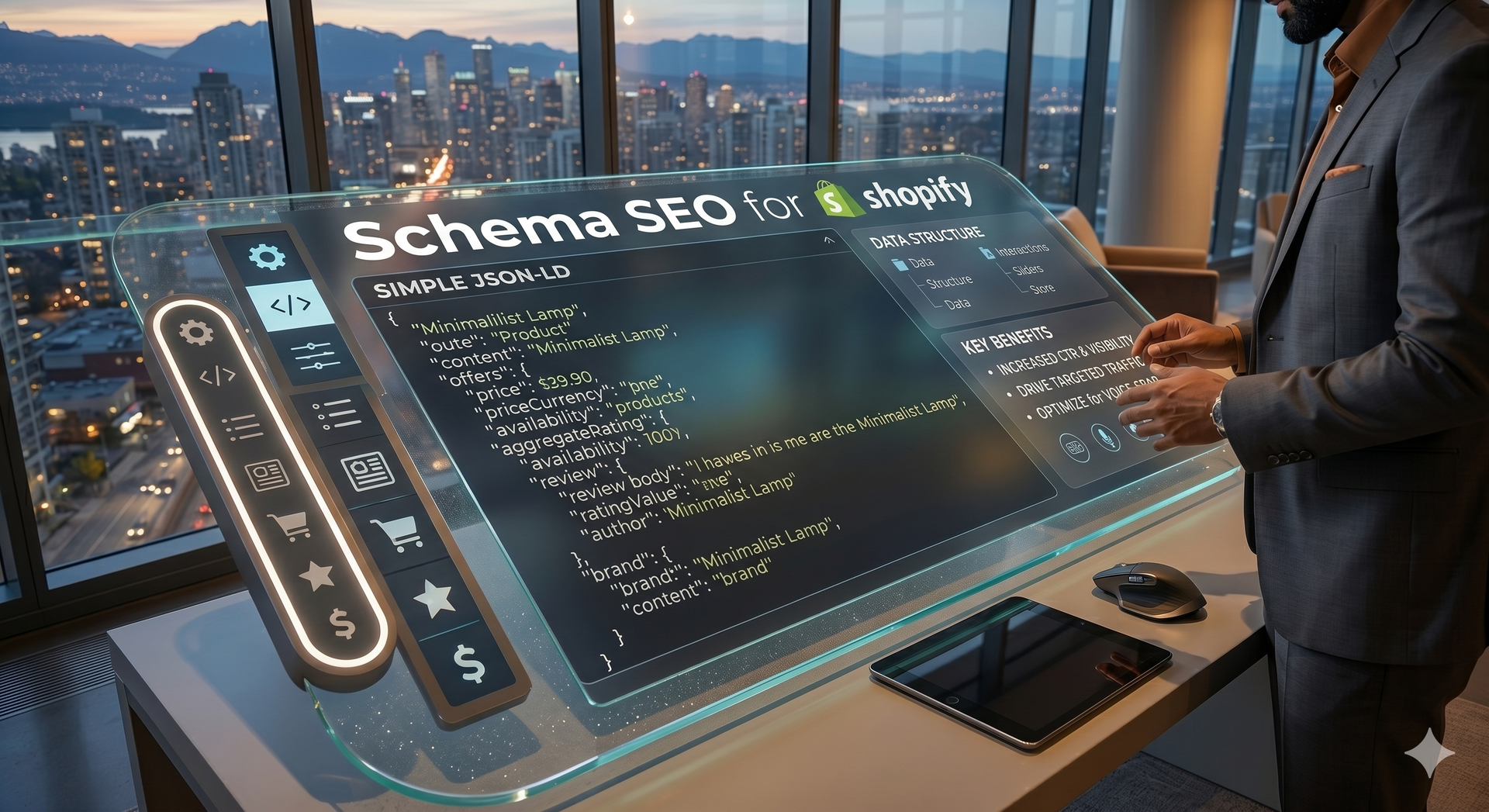
Schema SEO helps search engines and AI systems understand the information on your Shopify store. While shoppers see images, descriptions, and reviews, machines see structured data that explains exactly what those elements represent. This machine-readable layer helps power rich results and provides the context that answer engines need to interpret your products and content.
Different schema types communicate different information across your store. Together, they create a structured foundation that makes it easier for both search engines and AI platforms to understand and recommend your business.
| Schema Type | Why It Matters | How It's Typically Added |
|---|---|---|
| Product Schema | Helps search engines understand products and offers. | Theme |
| Review Schema | Provides social proof. | Review apps |
| Organization Schema | Establishes brand identity. | Theme or custom code |
| Collection Schema | Adds context to category pages. | Theme or custom code |
| Article Schema | Labels educational content. | Blog template |
| FAQ Schema | Structures common questions. | Apps or custom code |
| Breadcrumb Schema | Improves site hierarchy. | Theme |
| VideoObject Schema | Enhances video content. | Custom code |
| LocalBusiness Schema | Supports local discovery. | SEO apps or custom code |
Schema markup alone will not guarantee rankings or AI citations. However, it gives search engines and answer engines the structured information they need to understand your store with greater confidence. As search becomes increasingly driven by machines, Schema SEO has evolved from a technical enhancement into a foundational part of modern Shopify SEO.
Shopify AI SEO
AI search is changing how customers discover products online. Instead of presenting shoppers with a list of blue links, platforms like Google AI Overviews, ChatGPT, Gemini, and Perplexity increasingly generate recommendations directly from information gathered across the web.
Optimizing for these systems requires a different mindset. Success is no longer determined solely by rankings. It depends on whether AI platforms can understand your products, trust your brand, and confidently cite your information when answering customer questions.
Fortunately, many of the signals that support traditional SEO also benefit AI visibility. Strong brands, accurate product data, positive reviews, and well-structured content all contribute to making your store easier for answer engines to recommend.
| Question AI Asks | Signal It Uses | Examples |
|---|---|---|
| Who is this brand? | Entity signals | Organization schema, profiles |
| Can I trust it? | Merchant and review signals | Ratings, reviews, inventory |
| What does it sell? | Structured product information | Product pages and schema |
| What does it know? | Content depth | Guides, FAQs, comparisons |
| Is anyone else talking about it? | External consensus | PR, backlinks, brand mentions |
AI SEO does not replace traditional SEO. Instead, it builds on the same foundations while adapting them for a new generation of search experiences. Businesses that invest in machine-readable content, strong brand signals, and trustworthy information will be better positioned as search continues to evolve.
Measuring Shopify SEO Performance
Most Shopify merchants are already familiar with the traditional metrics. Organic traffic, conversions, and revenue should still be your primary measures of success, and tools like Google Analytics 4 make them easy to track.
However, modern SEO requires a broader perspective. As search evolves beyond blue links, brands should pay attention to several newer metrics that reveal how search engines and AI platforms discover, understand, and surface their content.
| Metric | Why It Matters | Tool |
|---|---|---|
| Rankings | Tracks visibility for your target keywords. | Google Search Console, Semrush |
| Rich Result Performance | Measures impressions and clicks from enhanced search features. | Google Search Console |
| Merchant Performance | Tracks visibility in Google's free shopping experiences. | Google Merchant Center |
| Branded Search Growth | Indicates growing awareness and trust in your brand. | Google Search Console, Google Trends |
| AI Citations | Measures mentions and visibility within answer engines. | Profound, Peec AI, Scrunch AI |
These metrics help uncover what we call the "Invisible Funnel." A shopper might first discover your products in a Google AI Overview, encounter your brand again in a product comparison, and only later search for your business by name before making a purchase. By monitoring both traditional and emerging metrics, Shopify merchants can better understand how customers discover brands in a zero-click world.
Future-Proof Your Store with a Shopify SEO Agency
The biggest risk in SEO is not making the wrong move. It's waiting too long while your competitors build an advantage that becomes increasingly difficult to overcome.
At Green Lotus Agency, we've helped clients generate more than $281 million in revenue through proven organic growth strategies. Our team understands that Shopify merchants do not have the time to keep up with every algorithm update, platform shift, and emerging search trend while running a business.
That's where we come in. As a leading Shopify SEO Agency, we provide data-driven Shopify SEO Services tailored to the unique challenges of ecommerce brands. Whether you need a complete SEO strategy, technical improvements, content development, or support adapting to AI-powered search, we'll help you build a sustainable competitive advantage before the gap becomes harder to close.
The brands that invest early often become the brands everyone else struggles to catch. Reach out to Green Lotus Agency today and let's build your growth engine for the next decade.
Frequently Asked Questions
Is Shopify good for SEO?
Yes, Shopify offers a highly stable framework for search marketing. It handles technical tasks like generating sitemaps and managing canonical links automatically. When you pair its native architecture with advanced schema markup and clean data structuring, it becomes an excellent tool for earning citations across conversational engines.
Does Shopify have SEO built in?
Shopify includes foundational tools like customizable title tags, image alt text adjustments, and standard redirects right out of the box. However, those basic settings are not enough to compete in a zero-click market. To win jobs, you must manually enhance your catalog with structured schema tags and conversational descriptions.
How long does Shopify SEO take?
It depends on your current web authority and how many competitors operate in your trade area. While broad terms take time, targeting clear conversational questions can show results relatively quickly. For example, our local service client, Visca Electric, updated their template system and achieved a 447% increase in first-page rankings within one year. They also secured 6 new placements inside Google AI summaries in just two months.
Is schema important for Shopify SEO?
Yes, schema markup is essential for modern visibility. It translates your regular website text into a format that search bots can verify with absolute certainty. Without proper product and review tags, conversational assistants cannot confirm your pricing or customer satisfaction scores, causing them to recommend a competitor instead.
Do backlinks still matter for Shopify SEO?
Backlinks matter, but their role has changed. It is no longer about buying thousands of low-quality links to cheat an algorithm. Modern engines treat links as independent validation. Getting mentioned on trusted industry portals, news sites, or trade directories proves to AI models that your company is a legitimate authority.