

What Is Schema SEO for Shopify? A Complete Guide to Structured Data Optimization
Bassem is a digital marketing, SEO, and AI strategist with more than 22+ years of experience managing online marketing strategies for some of Canada's and international corporations, including Canadian Tire, VistaPrint, Remax Canada, Egypt Air, Xplornet, Direct Energy, and Toronto Star.
Key Takeaway: Schema SEO transforms your Shopify store into a machine-readable database that search engines and AI platforms can understand, trust, and recommend. By implementing the right structured data, merchants can improve rich result visibility today while preparing for the future of AI-driven product discovery.
Your Shopify store might be completely invisible to the very systems influencing purchase decisions today. We have officially entered a zero-click reality where up to 60% of Google searches end without a single website visit. Why? Because answers are increasingly delivered directly to the user through AI Overviews, rich snippets, and generative search features. At the exact same time, high-intent shoppers are completely bypassing traditional results to ask ChatGPT, Gemini, and Perplexity for direct product recommendations instead of digging through pages of old blue links.
If your digital storefront is not engineered to act as a trusted, primary source of truth for these machine-learning systems, your products will become entirely invisible right when a customer is standing by with an open wallet. Clinging to obsolete tactics means you are essentially shouting your brand's message into an empty void while your direct competitors walk away with all the cash.
To win in this new ecosystem, you must master Schema SEO for Shopify. Schema markup provides the machine-readable information that search engines and AI systems use to interpret your store. This comprehensive guide breaks down the core structural framework of Shopify Schema SEO, explains how it connects back to your storefront architecture, and provides the exact steps to unlock explosive lead generation and sales.
What is an eCommerce Schema?
eCommerce schema is a standardized language of code embedded into your online storefront that explicitly defines your product details, prices, and business information for search engine crawlers. While human shoppers look at beautiful graphic banners, lifestyle photography, and sleek typography, search engine robots see your website through raw data structures.
To a shopper visiting your store, your product page presents a visual title, a descriptive text block, and bullet points:
Premium All-Weather Roof Shingles Protect your home with our heavy-duty architectural asphalt shingles, engineered specifically to withstand harsh winters.
- Price: $89.50 CAD
- Availability: In Stock
- Rating: 4.9 out of 5 stars (based on 142 customer reviews)
While the customer enjoys the clean design layout, search engine crawlers and conversational AI tools read the structured data script hidden in your backend theme layer:
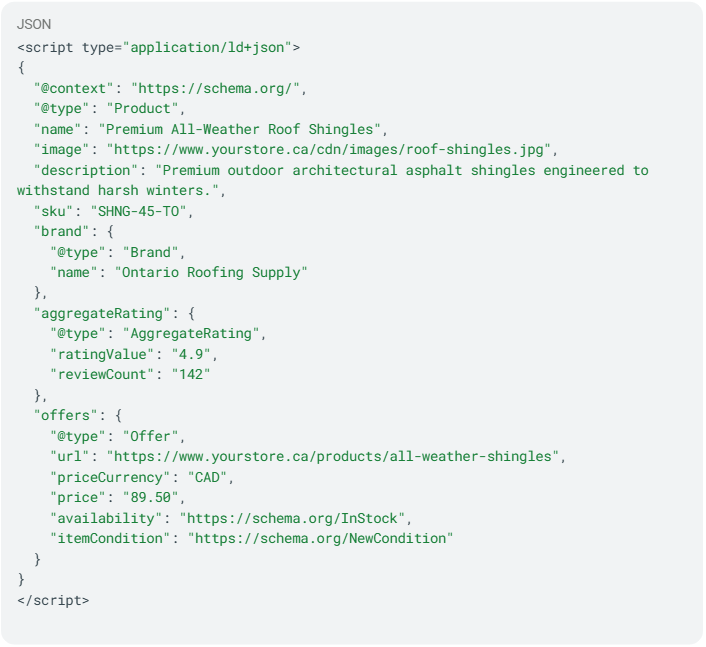
Without schema, a search engine bot has to guess whether a number like "$89.50" is a sale price, a shipping cost, or part of a product model number. By using ecommerce schema, you label that data explicitly. It transforms unstructured website text into a highly organized database that machine crawlers can scan, index, and verify instantly with 100% confidence.
Learn More About Schema SEO








What Is Schema SEO for Shopify?
Schema SEO for Shopify is the strategic practice of optimizing your backend code layer by embedding standardized data scripts directly into your Shopify theme, product templates, and collection architectures. Shopify is a fantastic platform out of the box, but many standard templates rely on heavy script execution and tangled code structures.
When you implement Schema SEO for Shopify, you clean up this technical hygiene. You ensure that your vital operational assets, like your product variants, real-time pricing tiers, inventory stock levels, and customer ratings, are translated into clean, machine-readable data blocks. Optimization means changing your mindset so your storefront does more than look pretty. It must be engineered as a high-clarity data source that automated bots can crawl, index, and retrieve without a single millisecond of digital friction.
Before we go any further, we need to address a major point of confusion that trips up almost every single Shopify merchant we speak with.
If you mention the word schema to a web developer, they might start talking about theme customizers, drag-and-drop sections, and editing panels. But if you mention schema to a digital marketing expert, they are talking about search engine visibility, AI summaries, and rich snippets. They are both right, but they are talking about two completely different things inside the Shopify ecosystem.
Let us clear up the confusion right now so you can navigate your store settings like a pro.
This is paragraph text. Click it or hit the Manage Text button to change the font, colour, size, format and more. To set up site-wide paragraph and title styles, go to Site Theme.
| Schema Type | What It Does | Who Reads It |
|---|---|---|
| Schema.org | Embedded JSON-LD code snippets that tell bots exactly what your content represents to drive your digital marketing, local SEO, and AI visibility. | Search engings and Large Language Models (e.g. ChatGPT, Gemini, Claude, etc.) |
| Liquid Schema | Internal {% schema %} Liquid tags that configure your theme settings, allowing you to edit text, list categories, or toggle features without breaking layouts. | Human Editors and Shopify store administrators. |
For the rest of this guide, whenever we use the term schema, we are talking exclusively about Schema.org structured data. This is the hidden code layer that will transform your Shopify storefront into an AI-friendly powerhouse.
Why Schema SEO Matters for Shopify Stores
Schema markup is not new. Search engines have relied on structured data for years. What has changed is how much visibility now depends on it.
Structured data directly powers many of the rich results shoppers encounter in Google, including product prices, star ratings, stock availability, and FAQs. These enhancements help your listings stand out and provide useful information before a customer even clicks through to your website. The impact can be substantial. Nestlé reported an 82% increase in click-through rates after implementing structured data, demonstrating how better machine understanding can translate into greater traffic and engagement.
The importance of schema has only grown with the rise of AI search. Platforms like Google AI Overviews, ChatGPT, Gemini, and Perplexity do not simply match keywords to pages. They gather information from across the web and organize it into answers and recommendations. To do this effectively, they need structured and trustworthy information.
Schema markup provides that layer of clarity. It helps answer engines understand important details such as your products, prices, reviews, and business information. By explicitly defining these entities and attributes, you make it easier for machines to interpret your storefront with confidence. Recent research found that pages with FAQ schema were 3.2 times more likely to appear in Google's AI Overviews, suggesting that structured data can make content more accessible to AI systems.
This is one reason Schema SEO plays an important role in both Generative Engine Optimization (GEO) and Large Language Model Optimization (LLMO). Unlike traditional SEO, which focuses primarily on ranking pages, these emerging disciplines focus on making information easier for AI systems to understand, retrieve, and cite. Schema markup provides the context that helps connect products, brands, reviews, articles, and other entities together.
Implementing schema alone will not guarantee rankings or AI citations. However, as search continues to shift toward zero-click experiences and AI-generated answers, making your Shopify store easier for machines to understand may become one of the simplest and most effective ways to protect your visibility across both traditional search engines and emerging answer engines.
Essential Schema Markup for Shopify
To help you prioritize your technical hygiene tasks without getting overwhelmed, we have broken down these code frameworks based on their absolute impact and effort. There are actually hundreds of individual schema vocabulary types available across the web, ranging from medical records to recipes. Trying to sort through all of them is an absolute nightmare, but the great news is that for an eCommerce store, you only need to focus on a handful of critical data structures to completely transform your digital marketing and local SEO.
We have filtered out the noise and organized the vital schema models into three distinct, manageable categories so you can ship the core essentials immediately before moving on to the advanced layers.
Must-Have Schemas
The frameworks in this category are foundational to any basic eCommerce schema SEO strategy. Without these structures, search engine bots and automated shopping tools cannot decipher your core commercial data, causing your store to miss out on high-intent buyers who are ready to purchase.
| Schema Type | What It Is | What It Does for Your Shopify Store |
|---|---|---|
| Product Schema | Core eCommerce data layer. | Enables price and live availability snippets directly on Product Detail Pages. |
| Organization Schema | Corporate identity framework. | Feeds the brand knowledge panel and builds machine trust. |
| BreadcrumbList Schema | Structural navigation trail. | Replaces messy URL lines in search results with a readable category path. |
This first tier is your baseline requirement for the modern web. Product schema is the single most important asset here because it puts your live data into a standard framework that search networks demand. If your theme leaves this out, your items will fail to appear as shoppable listings. Meanwhile, Organization and BreadcrumbList markup work together sitewide to prove to search bots that your store is a verified, logically structured brand entity rather than a disconnected web page.
Nice-to-Have Schemas
The frameworks in this category serve as brilliant accelerators for your conversion rates and contextual understanding. They require a bit more structured content setup but provide an immediate visual payoff in traditional search and a massive trust signal for generative AI shopping systems.
| Schema Type | What It Is | What It Does for Your Shopify Store |
|---|---|---|
| AggregateRating with Review | Onsite customer feedback score. | Displays the gold star row natively under your product search listings. |
| OfferCatalog / CollectionPage | Category identifier code block. | Identifies collection folders as lists of shoppable products, not long articles. |
| Article Schema | Specialized publisher tag. | Enables rich results for your educational resources and blog articles. |
| FAQPage Schema | Question-and-answer format. | Structures informational text blocks into modular chunks for voice assistants. |
This category is where you build true competitive authority. Implementing AggregateRating with Review schema pulls your real-world customer scores straight into the search results page. This single addition creates massive psychological social proof that naturally hooks a shopper's attention and drives up click-through rates. Furthermore, using OfferCatalog and Article markup gives answer engines the explicit context they need to separate your commercial inventory from your informational blog clusters, making your entire store far easier for software to scan and recommend.
Optional/Conditional Schemas
The frameworks in this tier should only be deployed on pages that actually contain these specific elements. They provide a massive edge for localized brands, voice search discovery, and rich video assets, but the visible payoff depends entirely on your specific business model.
| Schema Type | What It Is | What It Does for Your Shopify Store |
|---|---|---|
| LocalBusiness Schema | Geographic footprint indicator. | Confirms your precise physical location and regional business authority. |
| VideoObject Schema | Media breakdown data tag. | Pulls product demonstration details directly into search video results. |
| SearchAction Schema | Direct store utility snippet. | Generates a custom sitelinks search box inside your main Google listing. |
This final category covers specialized opportunities based on how your business operates. If you serve specific cities or regional markets, LocalBusiness schema helps anchor your store to those geographic areas and reinforces your local relevance. Likewise, if your product pages contain videos, implementing VideoObject schema gives search engines and answer engines additional context about that content. These schema types may not be essential for every Shopify store, but they can provide an additional layer of visibility in the right scenarios.
How to Add Schema Markup for Shopify
Implementing schema on Shopify does not have to be complicated. In many cases, your theme, apps, and existing content already provide the foundation. The key is understanding which schema types matter most and where they are typically implemented.
Product Schema
Product schema is the foundation of Schema SEO for Shopify. It tells search engines and AI systems what you sell, how much it costs, and whether it is in stock. Most modern themes generate Product schema automatically, although advanced stores may choose to customize it.
Review and AggregateRating Schema
Review and AggregateRating schema bring customer feedback into the search experience. Many review apps, including Judge.me, Loox, Yotpo, and Stamped, automatically generate this markup. To avoid conflicting signals, make sure only one source controls your review schema.
Organization Schema
Organization schema helps search engines understand the brand behind your store. Typically added on the homepage, it includes information such as your business name, logo, website URL, and social profiles.
Collection Schema
Collection schema gives search engines additional context about category pages and the products they contain. Depending on your theme and setup, this markup may already exist or require custom implementation.
Article Schema
Blog content should use Article or BlogPosting schema to identify headlines, authors, publication dates, and publisher information. Many Shopify themes support this by default, making it one of the easiest schema types to implement.
FAQ Schema
FAQ schema works best when your pages contain genuine questions and answers. Whether added through an app or custom code, the markup should always reflect content that is visible to users.
Breadcrumb Schema
Breadcrumb schema helps search engines understand how pages relate to one another. Most modern themes include this automatically, making it a simple but important part of your store's structured data foundation.
VideoObject Schema
If your product pages or blog posts contain videos, consider implementing VideoObject schema. This provides additional context about the video's title, thumbnail, and duration, making it easier for search engines and AI systems to understand and surface that content.
LocalBusiness Schema
LocalBusiness schema is especially valuable for merchants serving specific cities or regional markets. It helps connect your store with nearby customers and provides important business details such as location, hours, and service areas.
No matter which schema types you implement, accuracy matters more than quantity. After adding structured data, always validate your markup to ensure search engines and AI systems can interpret it correctly.
How to Measure eCommerce Schema SEO Performance
One advantage of Schema SEO is that its impact is relatively easy to monitor. While search engines do not reveal exactly how structured data influences rankings, they do provide several ways to measure whether your schema is improving visibility and generating results.
| Metric | What It Measures | Where to Measure It |
|---|---|---|
| Rich Result Impressions | How often your pages appear with enhanced search features such as product snippets, ratings, and FAQs. | Google Search Console |
| Rich Result Clicks and CTR | How many users click your rich results and how effectively those listings attract attention. | Google Search Console |
| Free Listing Impressions and Clicks | How frequently your products appear in Google's shopping experiences and how much traffic they generate. | Google Merchant Center |
| Organic Conversions and Revenue | Whether increased visibility from structured data is translating into sales and business outcomes. | Google Analytics 4 |
| Schema Errors and Warnings | Whether missing fields or validation issues are preventing rich results from appearing. | Google Search Console and Rich Results Test |
Although there is currently no direct way to measure how often AI platforms like ChatGPT or Gemini use your content, improvements in rich result visibility, clicks, and conversions are strong indicators that search engines and answer engines are understanding your store more effectively.
Build an AI-Friendly Shopify Store with a Schema SEO Agency
The way consumers discover products and shop online has permanently changed. The rise of advanced conversational answer engines means you can no longer just drop items onto an empty grid, add a few basic keywords, and hope for clicks. To survive the zero-click reality and future-proof your business, you must transform your digital storefront into a clean, machine-readable database that AI systems can instantly understand, trust, and cite.
Building an airtight technical foundation through strategic Shopify Schema SEO is one of the single most effective ways to level the playing field. It allows agile independent stores to compete head-to-head with massive online marketplaces, capture highly motivated buyers at peak purchase intent, and build long-term authority within their niche.
If managing code syntax, optimizing structured data feeds, or building out topical content clusters feels overwhelming, remember that you do not have to tackle this digital shift alone. Our team at Green Lotus Agency provides practical local SEO, sales automation, and advanced digital marketing services to help small businesses across North America scale with confidence.
Let us build your custom visibility playbook and implement our specialized Schema SEO Services to protect your brand entity and supercharge your organic reach. Contact Green Lotus Digital Marketing Agency today to schedule a strategic review of your store
Frequently Asked Questions
Is schema markup a ranking factor?
No. Schema markup is not a direct ranking factor. However, it can improve visibility through rich results, increase click-through rates, and make it easier for search engines and AI platforms to understand your store.
Can schema markup improve click-through rates?
Yes. Structured data can enable rich results such as prices, ratings, and FAQs that make listings more attractive. Google case studies have shown that some brands experienced significant increases in click-through rates after implementing schema markup.
How do I test my Shopify schema?
You can validate your structured data using Google's Rich Results Test, Schema Markup Validator, and the structured data reports inside Google Search Console.
How long does it take for schema markup to show results?
There is no fixed timeline. Search engines first need to crawl and process the updated markup. Depending on crawl frequency and competition, improvements in rich results and click-through rates may take anywhere from a few days to several weeks.